 Aavtaar
Call Center Burnout Is a Staffing Problem. Here's the Other Fix.
Ask most call center leaders why their agents are burning out, and you'll hear the same answer: "We're understaffed."
It's a reasonable diagnosis. When queues are long and shifts are stretched, agents feel it first. So the standard response is to hire more people, build bigger teams, and add night shifts.
But anyone who has tried this knows the pattern. You hire, you train, and a few months later some of those new agents are burning out too. Turnover climbs, training costs pile up, and the queue is still long.
That suggests headcount is only half the story. The other half is what your agents spend their day doing.
Why Hiring More Agents Doesn't Fully Solve Burnout
Staffing shortages do contribute to burnout. Fewer people means longer hours, fewer breaks, and more pressure on everyone still on the floor.
But adding people to the same broken workflow simply spreads the same stress across more heads. If each agent still spends most of their shift on repetitive, low-value work, the burnout follows them.
Consider what a typical agent's day looks like:
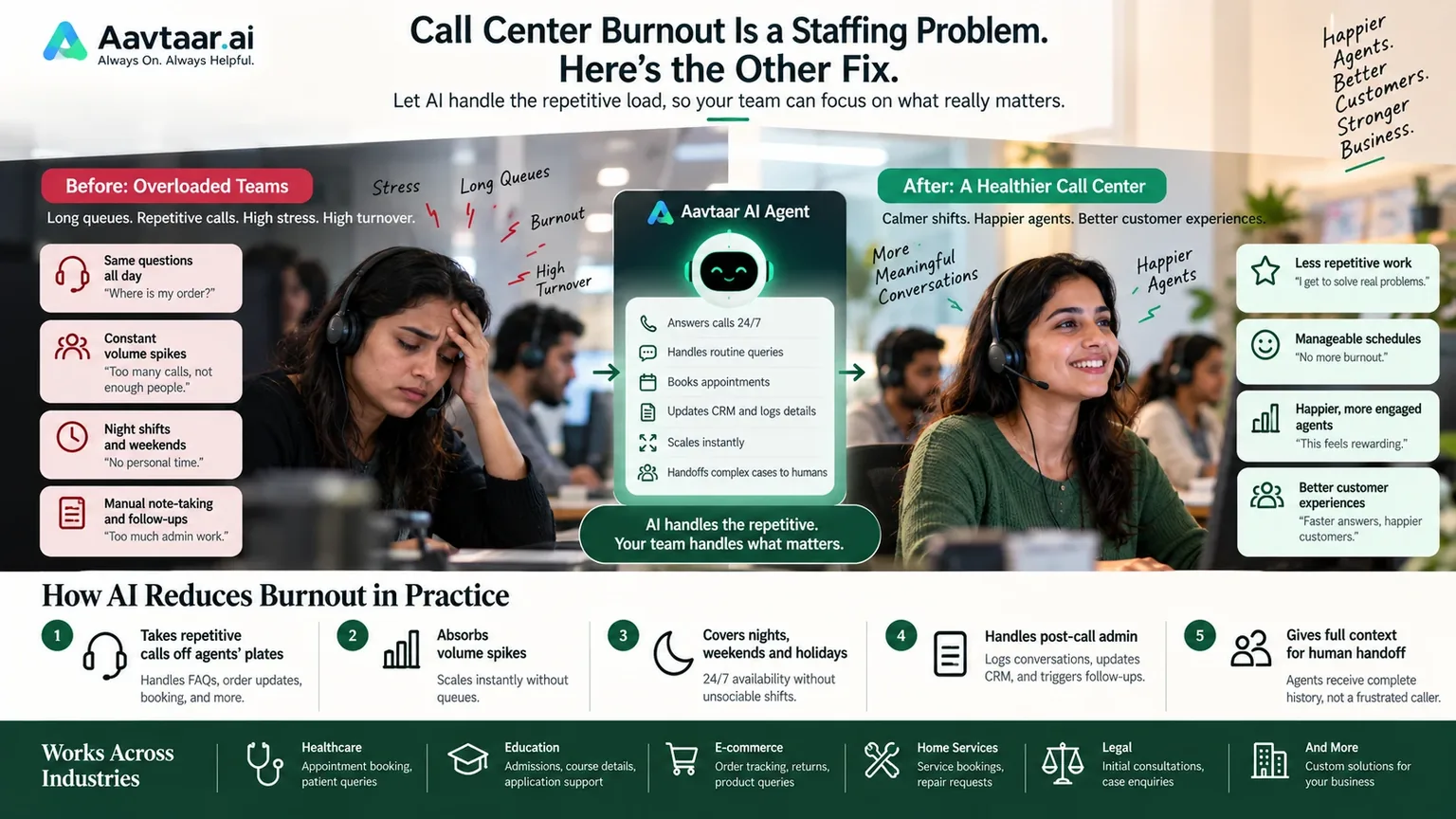
- Answering the same handful of questions dozens of times (order status, opening hours, fee structures, password resets)
- Taking calls that could be resolved with a single piece of information
- Manually logging notes, updating records, and chasing follow-ups
- Handling volume spikes with no warning
- Working odd hours to cover nights, weekends, and holidays
None of this is difficult. It's just relentless. And relentless, repetitive work is one of the fastest routes to exhaustion, disengagement, and eventually resignation.
The problem isn't only how many people you have. It's how much of their energy goes on work that doesn't need a person.
The Hidden Cost of Agent Turnover
Burnout isn't just a wellbeing issue. It's a business one.
Every agent who leaves takes product knowledge, customer familiarity, and hard-won experience with them. Replacing them means recruiting, onboarding, and weeks of reduced productivity while the new hire ramps up.
Customers feel it too. Stressed, overloaded agents rush calls, sound tired, and have less patience for complicated problems. Service quality drops exactly when it matters most, and unhappy customers create even more difficult calls, feeding the cycle.
Breaking that cycle means changing the work itself.
The Other Fix: Let AI Handle the Repetitive Load
The second lever is workload redesign, and AI agents are the most practical tool for it today.
Modern AI voice, chat, and email agents can hold natural conversations, understand what customers want, and complete tasks like booking appointments, answering FAQs, sharing order updates, and qualifying enquiries. They do this instantly and around the clock.
The idea isn't to replace your team. It's to stop wasting your team on tasks that don't need human judgment. Let AI absorb the predictable, high-volume conversations, and let people focus on the calls where empathy, creativity, and problem-solving actually matter.
How AI Reduces Burnout in Practice
1. It Takes the Repetitive Calls Off Agents' Plates
The single biggest source of monotony is answering identical questions all day. An AI agent can handle these routine conversations from start to finish, resolving them without a human ever picking up. Agents no longer start each shift facing a wall of "where is my order?" calls.
2. It Absorbs Volume Spikes
Sudden surges, such as admissions season, a billing cycle, a product launch, or a service outage, are a major stressor. Staffing for peak volume is expensive, and staffing for average volume leaves agents underwater when spikes hit.
AI scales instantly. It can answer every call in a surge without a queue, so your team isn't forced into panic mode.
3. It Covers Nights, Weekends, and Holidays
Round-the-clock coverage often means unsociable shifts, which is a well-known driver of fatigue and attrition. An AI agent handles after-hours calls, so your team can work regular, predictable schedules and still offer 24/7 availability to customers.
4. It Handles the Admin That Follows Every Call
Note-taking, CRM updates, and follow-ups quietly eat into an agent's day. AI agents can log conversations, sync outcomes to your CRM or helpdesk, and trigger follow-ups automatically. That means less after-call work and more time to breathe between conversations.
5. It Gives Agents Context When They Do Step In
When a conversation genuinely needs a human, a well-built AI passes it over with the full history attached. Agents don't inherit a frustrated customer who has already explained everything twice. They start with the facts, which makes difficult calls calmer and shorter.
What Agents Do With That Time
Removing the repetitive work doesn't leave agents idle. It changes what their job is.
Instead of reading the same answers from a script, they handle the complex cases, retain at-risk customers, resolve sensitive complaints, and build relationships. That work is more varied, more skilled, and more rewarding.
For many teams, this shifts the role from "call handler" to "customer problem-solver," which is a much better reason for someone to stay.
What to Look For in an AI Solution
If you're considering automation as part of your burnout strategy, make sure it's built to support your team rather than create new headaches:
- Human handoff built in. Escalation should be instant and carry full context.
- Natural conversation. Customers shouldn't feel like they're fighting a menu.
- Easy training on your content. The AI should learn your FAQs, policies, and tone.
- Integrations. It should connect with your CRM, calendar, and helpdesk.
- Analytics. You need visibility into what's being handled and where humans are still needed.
- Fast deployment. You shouldn't wait months to see relief.
To see how this works at scale, explore Aavtaar's AI call center solution. If your burnout pressure comes mainly from support volume, take a look at how AI customer support can take on the repetitive queries while your team handles the conversations that need them.
Call center burnout does have a staffing component, but treating it as only a staffing problem keeps leaders stuck in a loop of hiring, training, and losing people.
The other fix is to redesign the workload. When AI handles the repetitive, high-volume, always-on work, your agents get manageable schedules, calmer shifts, and more meaningful conversations. Customers get faster answers. And your team has a real reason to stay.
Hiring will always matter. But the healthiest call centers won't just have more people. They'll ask their people to do less of what wears them down.