 Aavtaar
How AI Answering Services Handle After-Hours Calls Without Sounding Robotic
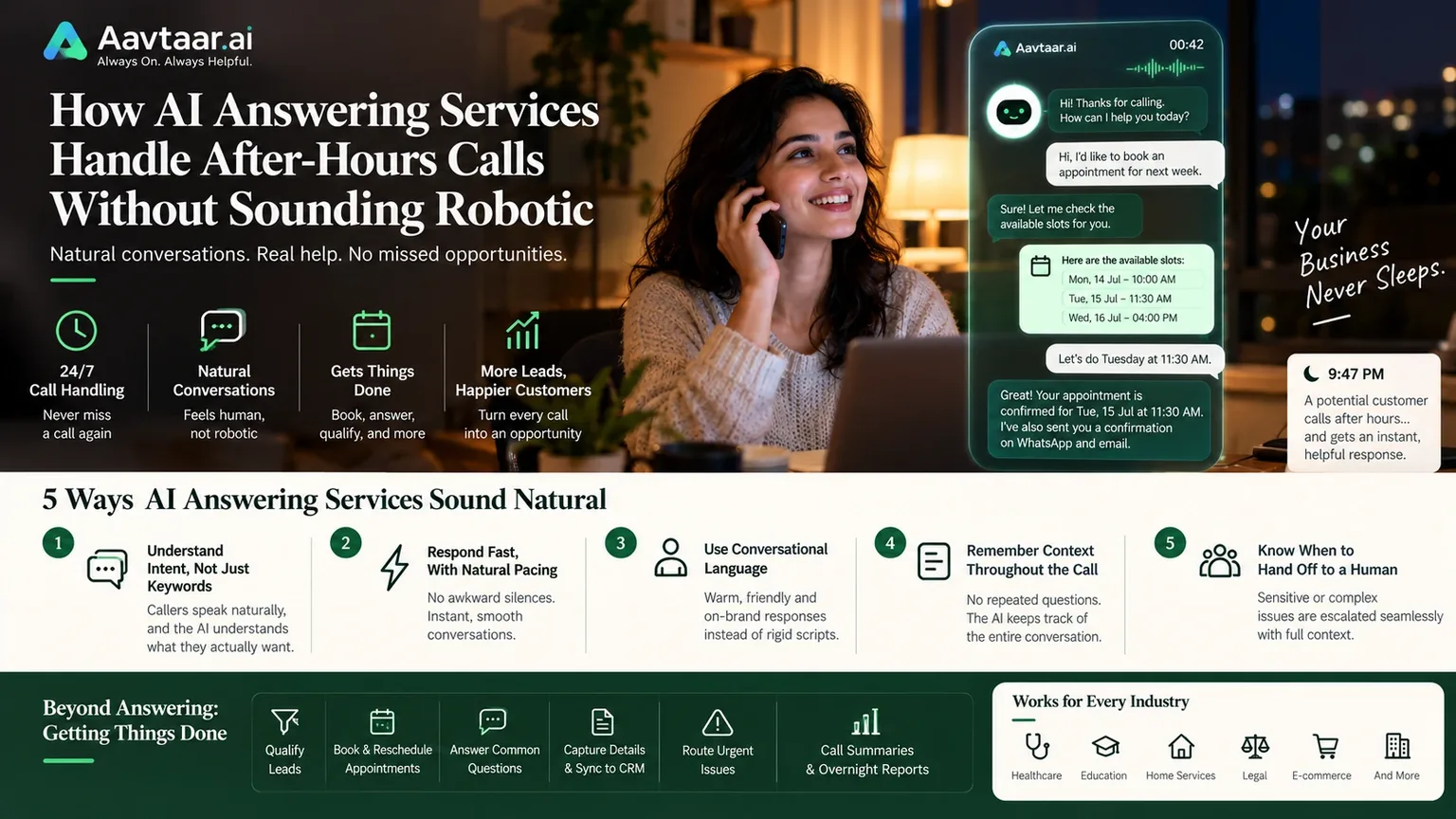
It's 9:47 pm. A potential customer has just finished comparing options and picks up the phone to call yours. Your office is closed. The call rings out, or worse, drops into a voicemail box that nobody checks until morning.
By then, that customer has probably called a competitor.
After-hours calls are among the most valuable and most neglected touchpoints in any business. People who call outside working hours are often ready to act: to book an appointment, report an urgent problem, or ask a question that decides whether they buy. Missing those calls is expensive.
The old fixes aren't great either. Overnight staffing is costly, traditional answering services read from scripts, and rigid phone menus ("press 1 for sales, press 2 for support") frustrate people. That's why more businesses are turning to an AI answering service. But one question comes up every time: will it sound like a robot?
The honest answer is that it depends on how the technology is built. Here's how modern AI handles after-hours calls in a way that feels natural, helpful, and human.
Why Robotic Call Experiences Hurt Your Business
We all know the sound of a bad automated call: long pauses, stiff phrasing, and a voice that keeps saying "I didn't understand that" no matter how clearly you speak.
The damage goes beyond annoyance. A robotic experience signals that the customer isn't important enough for a real conversation. It creates friction at the exact moment someone is trying to reach you, and many callers simply hang up rather than fight the system.
A well-designed AI voice agent is a different thing entirely. Instead of forcing callers through fixed menus, it holds a real, flowing conversation.
5 Ways AI Answering Services Sound Natural
1. They Understand Intent, Not Just Keywords
Older systems listened for specific words and matched them to a menu option. If you said something slightly different, they got lost.
Modern AI uses natural language understanding to work out what the caller actually wants. Someone can say "I need to move my appointment to later in the week" or "Can I come in Thursday instead?" and the AI understands both mean the same thing. Callers speak the way they normally would, and the AI adapts to them.
2. They Respond Fast, With Natural Pacing
Awkward silence is one of the biggest giveaways of a machine. Today's best AI voice agents respond in a fraction of a second, with pacing that mirrors a real conversation. They handle interruptions gracefully too. If a caller cuts in mid-sentence, the AI stops, listens, and adjusts, just as a person would.
3. They Use Conversational Language
Natural conversations are full of small human touches: acknowledgements, confirmations, and a warm tone. Instead of reciting a rigid script, a good AI agent says things like "Happy to help with that. Let me check what's available," and confirms details back in plain language.
This is also why training matters. The best systems learn from your FAQs, documents, and tone of voice, so the AI sounds like your brand rather than a generic assistant.
4. They Remember Context Throughout the Call
Few things feel more robotic than being asked the same question twice. A capable AI answering service keeps track of everything said during the conversation. If you've already shared your name and reason for calling, it won't ask again. It carries context forward, so the call feels like a single coherent exchange rather than a series of disconnected prompts.
5. They Know When to Hand Off to a Human
Sounding human also means knowing your limits. The most convincing AI systems recognize when a situation calls for a person: an upset caller, a sensitive issue, or a genuine emergency.
Instead of trapping the caller in a loop, the AI escalates with full context, so the human who picks up already knows what happened. Nobody has to start over, and the customer feels heard.
What an After-Hours AI Call Actually Looks Like
Imagine a patient calling a clinic at 8:30 pm:
- The AI answers instantly, greets the caller, and asks how it can help.
- The patient says they'd like to see a doctor early next week.
- The AI checks the calendar, offers available slots, and books the appointment.
- It confirms the details and sends a reminder.
- If the patient mentions severe symptoms, the AI routes the call to the on-call team immediately.
No voicemail, no waiting until morning, and no one lost along the way. The same flow works for a home-services company handling an urgent repair request, a law firm capturing a new enquiry, or an education provider fielding admissions questions at midnight.
Beyond Answering: Getting Things Done
The real value of a modern AI answering service isn't just picking up the phone. It's completing the task. A good system can:
- Qualify leads by asking the right questions and passing hot prospects to your sales team
- Book and reschedule appointments directly into your calendar
- Answer common questions about pricing, hours, policies, and availability
- Capture details and sync them to your CRM or helpdesk
- Route urgent issues to the right person straight away
Because everything is logged, you also start each morning with a clear record of what happened overnight, including call summaries, outcomes, and follow-ups.
How to Choose an AI Answering Service That Sounds Human
Not every solution delivers the same experience. When evaluating options, look for:
- Natural, low-latency conversation. Test it yourself and listen for pauses and stiffness.
- Customization. It should learn your business, terminology, and tone.
- Smart escalation. Human handoff should be built in, with context passed along.
- Integrations. It should connect to your calendar, CRM, and existing tools.
- Security and compliance. Especially important in healthcare, finance, and insurance.
- Fast setup. You shouldn't need months of development to go live.
If you're comparing solutions, explore Aavtaar's AI answering service to see how always-on call handling works in practice. For a closer look at the technology behind natural phone conversations, see the AI voice agent.